Unlocking the future of wearable intelligence with Wellyp Audio
In today’s rapidly evolving wearable-tech landscape, AI smart glasses are emerging as the bridge between human vision and artificial intelligence. This complete guide to AI glasses will lead you through what they are, how they work, why they matter — and most importantly, why Wellyp Audio is uniquely positioned to be your OEM/ODM partner for bringing them to market.
1. What Are AI Glasses?
AI glasses are wearable eyewear that look like regular glasses but integrate advanced hardware (cameras, microphones, sensors), connectivity (Bluetooth, WiFi), and intelligent software (AI translation, computer vision, voice assistants). According to Wellyp Audio’s website, their smart glasses “look like traditional eyewear but are equipped with built-in cameras, microphones, speakers, and advanced AI chips.
Unlike early smart glass attempts that simply added a display or a camera, true AI glasses incorporate real-time intelligence: object recognition, translation, conversational AI, paired with audio output and a comfortable wearable form-factor.
From a business vantage point, being early in the AI-glasses category means access to high-growth segments, especially as component cost declines and consumer readiness increases.
So if you’re exploring the category, these are the core elements to keep front and centre:
● Wearable form-factor (glasses)
● AI-enabled functions (translation, recognition, voice commands)
● Audio / visual output (speakers, display, HUD)
● Connectivity and data processing (on-device or cloud)
● Customisation possibilities (frames, lenses, branding)
2. Why AI Glasses Matter — And Why They Matter Now
Why should brands, OEMs, and distributors care about AI glasses? Several reasons:
Consumer & market trends
● Consumers increasingly demand **hands-free** experiences — checking notifications, translating speech, identifying surroundings without taking out a phone.
● Wearables are evolving beyond earbuds and watches — glasses bring vision + audio, which is a powerful combination.
● According to Wellyp Audio, smart glasses with camera + AI translator are redefining how people interact with the digital and physical worlds.
Business & OEM Opportunity
● For brands: AI glasses create a new category to differentiate and cross-sell. Think: AI glasses + high-fidelity audio (Wellyp’s specialty) = a premium wearable bundle.
● For OEM/ODM: Wellyp Audio emphasises they own a wireless glasses factory in China and provide OEM/ODM services including logos, frames, firmware, and packaging.
● For distributors: Growing interest in translation glasses, travel accessories, and enterprise wearables means early entrants can capture market share.
Technological readiness
● AI chips are now compact, power-efficient, enabling on-device or hybrid AI support (translation, object recognition).
● assistants, cloud APIs) make integration smoother. Wellyp lists Bluetooth version 5.3 in their spec.
● Consumer acceptance of wearable tech is higher — design, comfort, style matter more than ever (and Wellyp addresses lenses, photochromic options).
In short: the convergence of user demand + technological feasibility + manufacturing/ODM readiness means now is the time for AI smart glasses.
3. How AI Glasses Work – Key Technical Architecture
To effectively design, buy or customise AI glasses, you need to understand the technical building blocks. Based on Wellyp Audio’s specs and general industry knowledge, here is a breakdown:
Input & sensing
● Built-in camera (8 MP–12 MP) enables photo/video capture and computer vision tasks (object/scene/text recognition).
● Microphones (ambient + voice) to capture speech, commands, and environmental audio.
● Sensors (accelerometer, gyroscope, proximity) may detect head movement, gestures or orientation.
● Optional: Ambient light sensor, blue-light filter lens sensor (for photochromic functionality).
Processing & AI
● On-board AI chip/chipset such as JL AC7018 or BES series (listed by Wellyp) for stable AI processing.
● Software stack: translation engine (cloud & offline), voice assistant (e.g., ChatGPT-style), computer vision modules (recognition). Wellyp lists cloud-based translation with an optional offline mode.
● Connectivity to smartphone or cloud for heavier AI tasks, updates, and data sync.
Output & interface
● Audio: Micro-speaker or bone-conduction transducer embedded in the frame (Wellyp lists either micro-speaker or bone conduction).
● Visual: While not explicit in all models, some glasses include a subtle heads-up display or overlay, or simply deliver info via audio + voice. Wellyp mentions photochromic lenses (tinting), not necessarily a full AR HUD.
● User interface: Voice commands, touch controls on the frame, companion app for settings.
Connectivity & power
● Bluetooth version 5.3 (Wellyp) for low-latency, dual-device pairing.
● Charging: USB-C or magnetic pogo-pin for fast charge. Wellyp lists magnetic pogo-pin / USB-C.
● Battery life: Wellyp lists 6-8 hours active, ~150 hours standby.
Lenses & frames
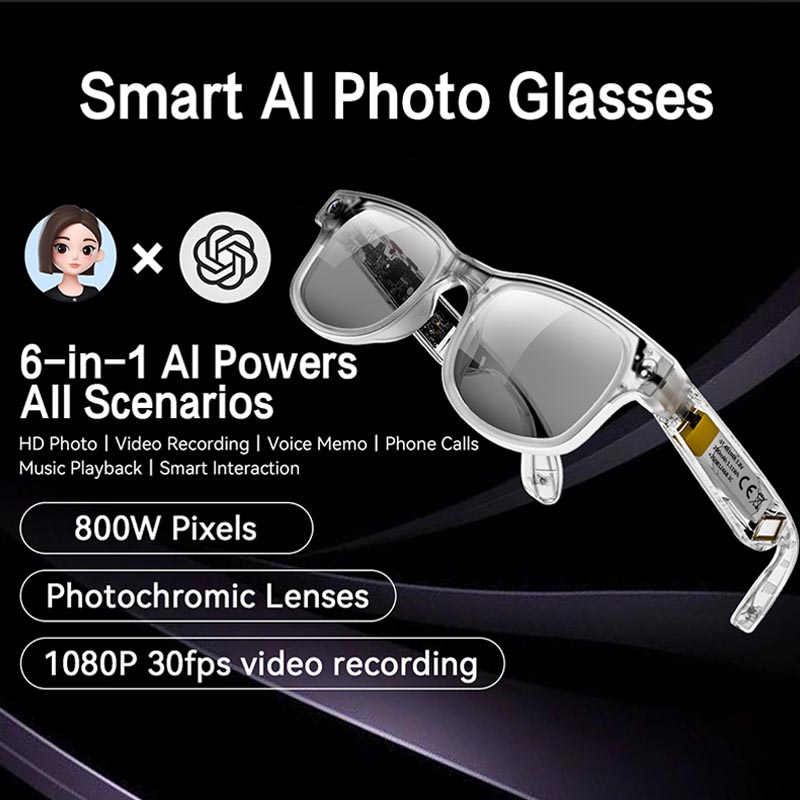
● Photochromic lenses that automatically adjust tint. Wellyp emphasises this.
● Options for blue-light filter, polarized lens, or prescription lens compatibility.
● Frame materials, style, branding: important for everyday wear comfort and fashion acceptance.
4. Key Features & Differentiators to Highlight
When marketing AI glasses (especially in OEM/wholesale context) these are the features you want to emphasise — and that Wellyp Audio offers.
High-Resolution Camera + Object Recognition
One major differentiator: The camera is not just for selfies, but for seeing and recognising. According to Wellyp: “8 MP–12 MP camera … One of the most impressive features … enables … object and scene recognition … identify buildings, plants, products, even text in real time.”
So you can highlight: Live translation of signage, product scanning in retail, and travel assistance.
Real-Time Translation
Crucial selling point: “Real-time speech-to-speech translation between multiple languages … subtitles or voice translation … offline translation capabilities for travel scenarios without internet access.” ([Wellyp Audio][1])
This opens up travel, language-learning, and global business use-cases.
Conversational AI / ChatGPT Integration
Wellyp mentions “ChatGPT AI integration … ask questions about what they see… travel guidance, restaurant recommendations, learning support.” This positions the glasses not just as hardware, but as a wearable assistant.
Lens & Frame Innovation
Photochromic lenses (automatic tinting), blue-light filtering, and prescription compatibility — all help convert from “tech gadget” to “everyday wear”. Wellyp lists these.
Thus, the comfort + fashion element is as important as technology.
OEM/ODM Customisation & Manufacturing Advantage
Wellyp’s positioning as a factory with OEM/ODM support is a strong differentiator:
● Owns factory (not just trading) → better cost control, quality.
● Customisation options: Logo, colour, packaging, firmware, lens type.
● Certifications and quality process (CE, FCC, RoHS).
This is especially attractive for brands/distributors wanting to private-label or launch with unique features.
5. Use-Cases & Application Scenarios
Understanding practical use-cases helps position AI glasses and tailor features accordingly. Wellyp lists several:
● Travel & Tourism: Real-time translation, navigation assistance, capturing experiences hands-free.
● Education & Training: Object recognition (identify parts, plants, landmarks, lab equipment), language learning, immersive classrooms.
● Business/Corporate: Global meetings with translation, hands-free documentation, and remote guidance in manufacturing/maintenance.
● Healthcare / Field Work: Wearables for medical professionals (visual assist), or for technicians doing on-site inspections.
● Retail & Customer Service: Assist staff in interacting with international customers, scanning products, managing inventory, and training.
● Lifestyle / Everyday Wear: Stylish frames with smart audio + translation, bridging tech and daily fashion.
By mapping use cases, you can emphasise different feature-sets (translation vs object recognition vs audio media) for different target markets.
6. The Future of AI Glasses: From Displays to Ambient Intelligence
Looking ahead, the technology and role of AI glasses are evolving rapidly. The shift is not just incremental — it’s structural.
Ambient, context-aware computing
Instead of being “glasses that do stuff”, the next generation will anticipate what you need: contextual prompts, proactive assistance, real-time environment interpretation, and minimal UI intrusion. The goal: digital assistance becomes part of your vision and hearing, without a full screen in front of you.
Miniaturisation, improved battery, better optics
Advances in optics (waveguides), sensors and low-power AI mean lighter form factors and longer all-day battery life. Research in AR/AI eyewear shows promising prototypes but also highlights energy-efficiency challenges.
Enterprise and consumer convergence
While early adoption has been in enterprise/industrial applications (field workers, warehouse navigation, medical assistants), the consumer market is rapidly catching up.
We can expect mainstream consumer AI glasses to become as common as smartwatches or true-wireless earbuds in the next 2-5 years.
Integration with other wearables and ecosystems
AI glasses will converge with other devices—earbuds, smartwatches, AR headsets—forming a connected wearable ecosystem. For Wellyp Audio, this means designing audio systems that integrate seamlessly into AI eyewear.
Beyond visuals: gesture, haptics & ambient audio
New inputs such as gesture tracking, haptic feedback, and ambient voice/ear audio will elevate the experience. Not all AI glasses will emphasise display — some will emphasise audio + gesture + environment. Research projects such as “LLM-Glasses” and “EgoTrigger” demonstrate how AI and sensor fusion enable novel experiences for navigation, memory assistance or accessibility.
7. How to Choose or Design AI Glasses — Buyer/OEM Checklist
If you’re a brand/distributor evaluating AI glasses or planning custom production, here’s a refined checklist inspired by Wellyp’s specs and best practices:
Fit with the target market
● What is the primary use case? Travel? Business? Casual lifestyle? The feature emphasis will differ.
● What price point makes sense for your region? OEM cost advantages matter.
Hardware & electronics
● Choose a stable AI chipset (such as JL AC7018 or BES series, as in Wellyp’s offering).
● Camera resolution (8–12 MP) and recognition software quality.
● Micro-speaker vs bone conduction — do you emphasise audio quality or open-ear awareness?
● Connectivity (Bluetooth version, dual-device pairing).
● Battery & charging method (6-8 hours active is a practical baseline per Wellyp).
Lenses & ergonomics
● Lens options: photochromic, blue-light filter, polarized, prescription compatibility.
● Frame design: weight, comfort, style acceptability in the target market.
● Manufacturing quality, user comfort for extended wear.
Software & AI experience
● Translation engine: multi-language support, offline mode capability (important for travel). Wellyp offers an offline mode.
● Conversational AI: integration with voice assistants, ability to ask questions about what you see.
● App ecosystem: companion apps, firmware updates, pairing with a smartphone.
● Privacy & security: data handling, camera indicator, user permissions.
Customisation & Brandability
● Branding: logo printing/engraving, custom colours, packaging. (Wellyp emphasises these)
● Lens customization: e.g., for your market, you might want specific lens coatings.
● Firmware/UI branding: Preload your app or translation API. (Wellyp supports API integration)
Quality control, certification & supply chain
● Check the factory owns a production line, not just a trading partner (helps cost, control). Wellyp claims this.
● Certification: CE, FCC, RoHS (mentioned by Wellyp)
● QC process: Incoming inspection, assembly & SMT, functional test, aging & stress tests.) Wellyp aligns with this.
● Export readiness: shipping (DDP), logistic support, after-sales service.
8. Why Partner with Wellyp Audio?
Here’s why Wellyp Audio stands out as an OEM/ODM partner for AI smart glasses:
● Factory-owned production: Not just a trading company, so you get direct factory pricing, greater control, and scalability.
● Specialisation in audio & wearable tech: With a strong background in wireless headphones, TWS, and audio modules, they bring real audio expertise to AI glasses.
● Customization breadth: From frame design, lens types, audio modules, firmware/app integration, and branding.
● Quality & certifications: They emphasise CE/FCC export readiness, QC workflows. ([Wellyp Audio][1])
● Global export experience: Support for global markets, including UK/EU distribution.
● Strong value proposition: For brands or retailers wanting to launch AI eyewear quickly with a reliable manufacturing partner.
9. Outlook: What’s Next for AI Glasses & How to Stay Ahead
Looking ahead, to make your brand succeed in AI glasses, you should anticipate the next waves of innovation.
● Tighter integration of audio + vision: Already Wellyp places audio module importance; future models will fuse 3-D spatial audio, ambient awareness, and gesture input.
● Reduced size & improved battery: As chips get smaller and power-efficient, future glasses will be lighter, slimmer, with longer battery life.
● More pervasive AI services: Real-time translation, object recognition, and context-aware suggestions will become standard rather than premium. Wellyp already offers many of these.
● Fashion-tech convergence: To become mass-market, the look must be as important as the tech. Frames, lenses, and style must match lifestyle. Photochromic and prescription lenses (as Wellyp offers) are good steps.
● Enterprise & verticals: Beyond consumer, AI glasses will expand into enterprise (manufacturing, logistics, healthcare) — customisation for those verticals may be a growth area.
● Software & ecosystem lock-in: Brands that provide companion apps, firmware updates, cloud services (translation engine, object recognition) will differentiate. Choose an OEM partner who supports this (like Wellyp).
10. Frequently Asked Questions (FAQs)
Q: What is the difference between smart glasses and AI glasses?
A: While “smart glasses” is a broad term (covers any glasses with extra tech: camera, audio, display), “AI glasses” emphasises integrated artificial intelligence — capable of contextual understanding, voice commands, translation, and active assistance beyond just notifications.
Q: Are AI glasses worth it?
A: For users who want to reduce smartphone-screen time, stay connected hands-free, benefit from instant translation or navigation, or adopt the next generation of wearable tech — yes. The value depends on how much you’ll use features like live translation, heads-up directions, and ambient assistants.
Q: Are AI glasses safe and private?
A: Reputable devices now emphasise data security and privacy. Many models omit cameras or include clear indicators. Always check the manufacturer’s data policy.
Q: Will AI glasses replace smartphones?
A: Not immediately. But many analysts believe smart glasses/AI eyewear are on the path to becoming a primary interface for personal computing, especially for hands-free, wearable interactions.
Q: What should I watch out for when buying wholesale?
A: Compatibility with local markets (UK/EU regulatory compliance), battery and service support, availability of customisation (frames, audio, AI modules), logistics, and warranty support.
11. Summary & Final Thoughts
In sum, AI glasses represent more than just smart eyewear — they are wearable intelligence that combine vision, audio and AI to offer new interaction paradigms. For a brand or OEM vantage point:
● Understand the key feature sets: camera + recognition, real-time translation, conversational AI, audio output, lens/frame comfort.
● Choose hardware specs and manufacturing partner accordingly (chipset, battery, connectivity, lenses, ergonomic design).
● Leverage customisation: branding, packaging, firmware, lens options, audio modules.
● Work with a factory-capable partner with quality, certification and global export experience.
● Stay ahead by targeting future trends: comfort, battery, AI services, fashion integration, and verticals.
If you’re ready to bring AI smart glasses to market — whether for travel, lifestyle, enterprise or custom brand launch — Wellypaudio offers a compelling platform: “Smart glasses with camera and AI translator function are no longer science fiction — they are a fast-growing reality.”
At Wellypaudio, we’re excited to help you design, customise, and deliver the next generation of wearable intelligence. Whether your focus is premium audio glasses, translation-enabled eyewear, or brand-customized smart frames, the vision is clear: hands-free intelligence, within your line of sight.
Ready to explore custom wearable smart glass solutions? Contact Wellypaudio today to discover how we can co-design your next-generation AI or AR smart eyewear for the global consumer and wholesale market.



Recommend Reading
Post time: Nov-08-2025